
Who decides whether a species is endangered?
November 02, 2026By Claudio Sillero
For conservationists, red has long been the colour of bad news. Green helps us assess recovery and success.
The IUCN Red List of Threatened Species was established in 1964 by the International Union for Conservation of Nature (IUCN); initially they were loose-leaf catalogues of qualitative expert opinions assessing threatened mammals and birds. Sixty years later, it has become one of conservation’s best-known tools: a global system for assessing how close species of animals, plants and fungi are to extinction.
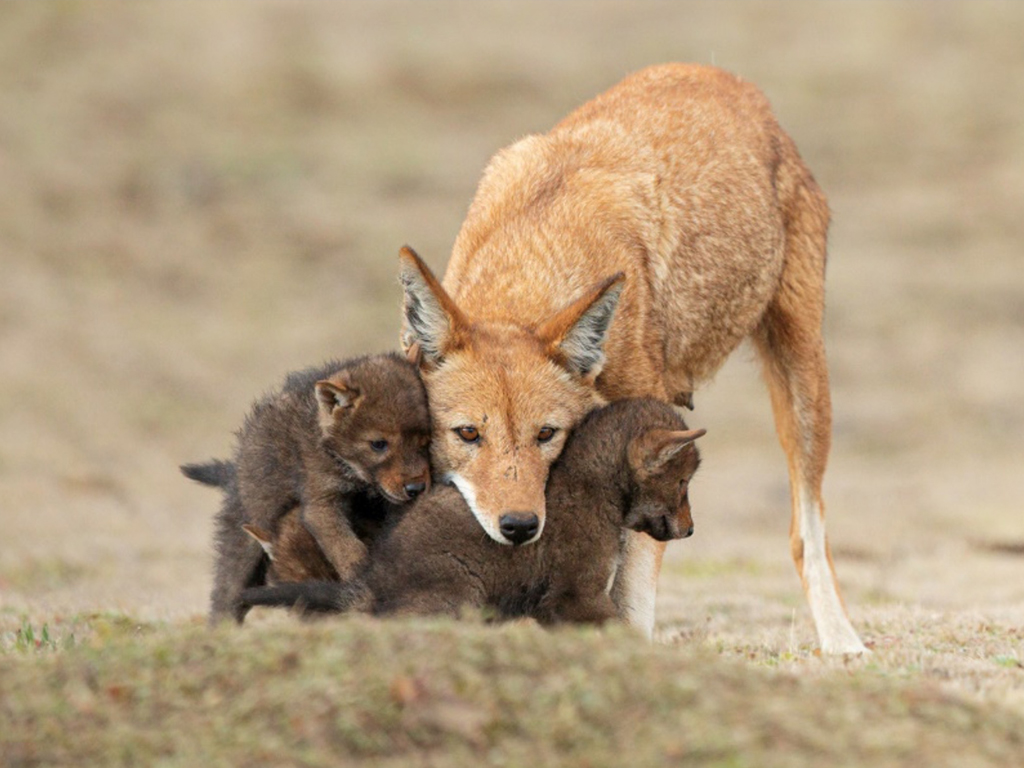
To date, the Red List has evaluated more than 175,900 species, with over 49,500 species currently listed as threatened with extinction.
Most people will be familiar with its language. Species can be Least Concern, Vulnerable, Endangered or, at the sharp end, Critically Endangered or even Extinct in the Wild. Behind these deceptively simple labels is a standardised assessment based on evidence such as population trends, population and range size and the degree to which populations are fragmented.
That standardisation matters. Before the Red List, recognising that a species was “rare” or “threatened” could mean rather different things to different people. The Red List gave conservation a common language for extinction risk – and, increasingly, a way of deciding where attention and action might be most urgently needed.
But there is a catch.
Imagine a species that was once abundant across a continent but is now confined to a small corner of its former range. Its remaining population might be stable enough for its immediate extinction risk to be relatively low. Yet calling that the end of the conservation story would feel rather unsatisfactory. Surviving is not necessarily the same as recovering.
RED → Where are we heading?
Risk of extinction, and change in that risk through time.
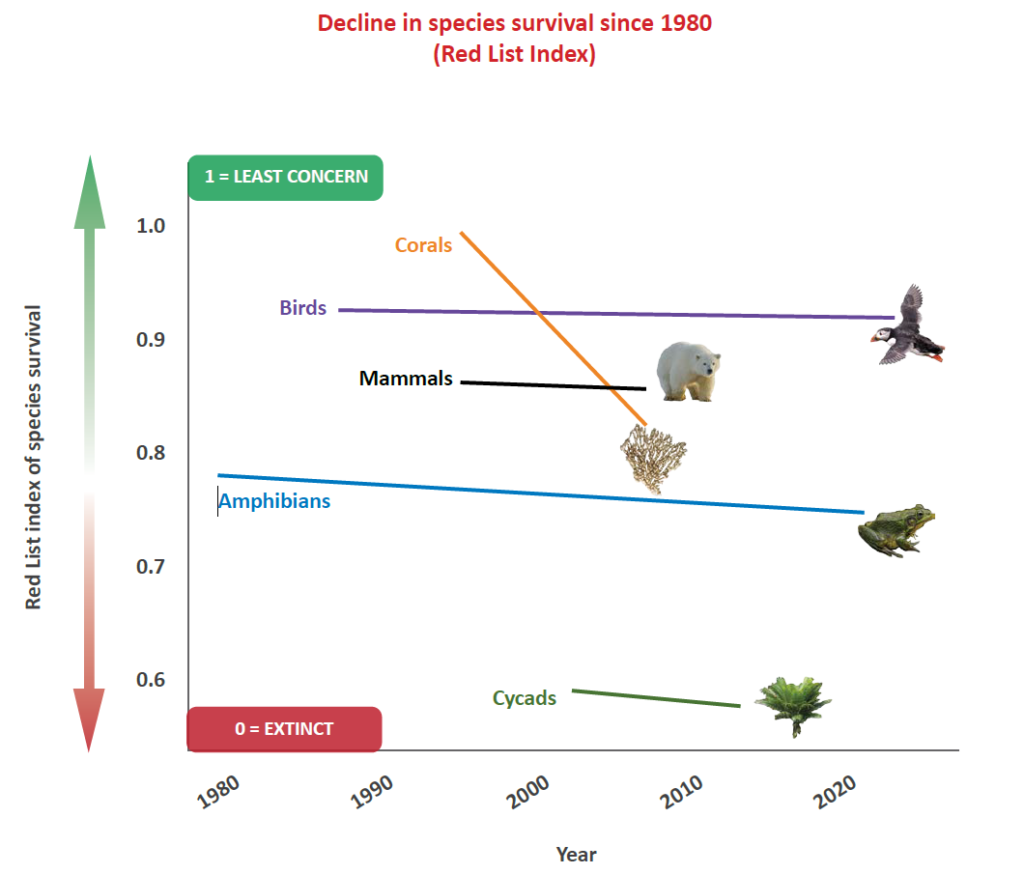
The Red List does more than label individual species. Repeated assessments allow the Red List Index to reveal whether extinction risk is increasing or decreasing across whole groups of species. © IUCN.
Seeing green
This is where the newer IUCN Green Status of Species comes in. Launched in 2021, the Green Status complements rather than replaces the Red List.
If the Red List essentially asks “How close is this species to extinction?”, the Green Status adds another question: “How close is it to being fully recovered?”
That seemingly small change in perspective opens up some interesting possibilities. A Green Status assessment considers whether a species is present, viable and performing its ecological functions across its indigenous range. Crucially, the benchmark is historical. This helps avoid the problem of shifting baselines, where each human generation can gradually come to accept an increasingly depleted natural world as normal.
It also allows us to ask what conservation has actually achieved.
Green Status assessments use different scenarios to estimate the Conservation Legacy – where a species might be today without past conservation – and its Conservation Dependence – what might happen if conservation action were to stop. They can also estimate the Conservation Gain expected from action over the next decade and the species’ longer-term Recovery Potential.
GREEN → What difference can conservation make?
Recovery relative to a historical baseline, including past impact and future potential.
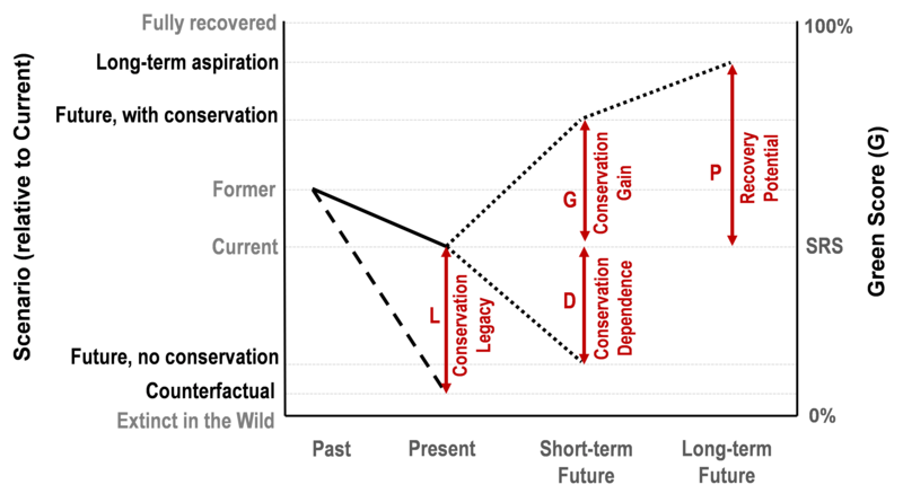
Green Status adds another dimension. It asks what conservation has already achieved, what would happen without it, what further gains are possible, and ultimately how far a species might recover. © IUCN.
This means conservation success need not be invisible simply because a species remains threatened. A Critically Endangered species may still represent an extraordinary conservation achievement if, without decades of intervention, it would already have disappeared. Conversely, a species classed as Least Concern can still be substantially depleted compared with its historical abundance, distribution and ecological function. The Red and Green assessments are telling us different – but complementary – parts of the same story.
What did past conservation save? → What happens if we stop? → What can we achieve in ten years? → How far could recovery ultimately go?
From species to the bigger picture
Things become particularly useful when we zoom out from individual species.
Repeated Red List assessments feed into the Red List Index, which tracks genuine changes in extinction risk across groups of species. Importantly, it does not simply count how many species appear on the Red List – a number that also changes as our knowledge and the number of assessments improve. Instead, it tracks genuine movement towards or away from extinction.
A complementary Green Status Index is being developed to do something similar for recovery: tracking genuine changes in how recovered species are through time.
Put the two together and we get a richer vocabulary for describing biodiversity change. Are species sliding towards extinction? Are conservation actions slowing that slide? Better still, are species actually recovering towards the abundance, distribution and ecological roles they once had?
For decades, conservation has become very good at documenting decline. Red remains essential for telling us where the danger lies. Adding green gives us something equally important: a way of asking whether our efforts are moving nature in the other direction.