
Gus Mills – reflections on a friendship
July 20, 2026Written by David Macdonald
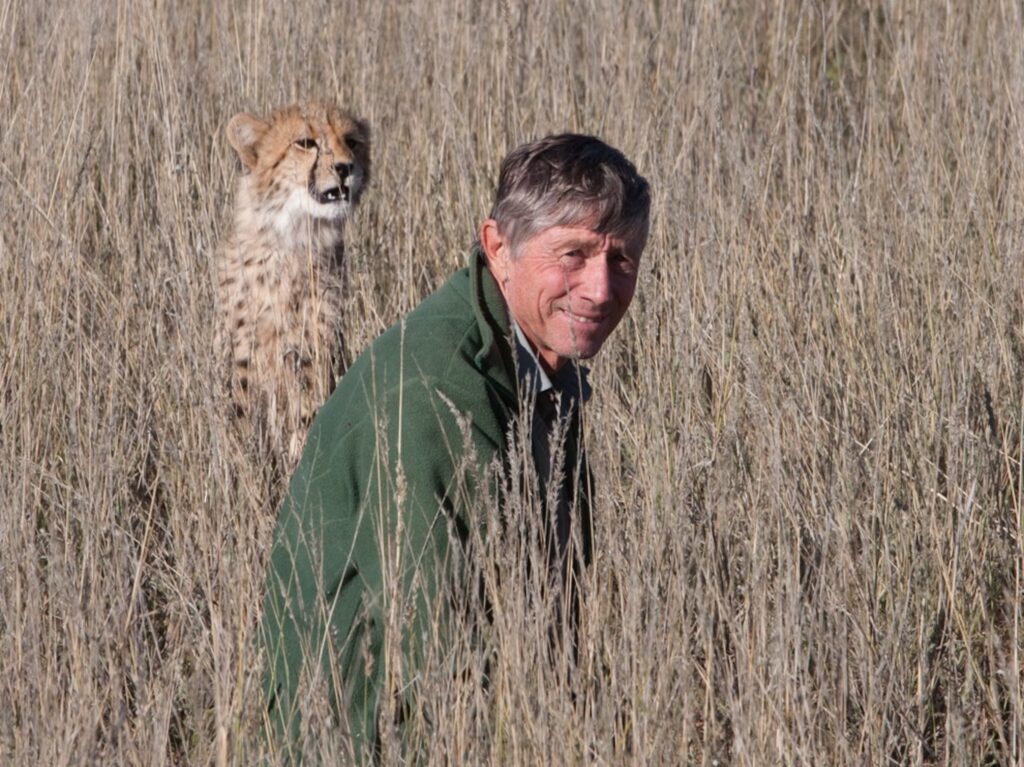
Photograph by Margie Mills
It all began in 1972. Gus headed to the Kalahari’s brown hyaenas, and I to Oxfordshire’s red foxes. The first link between us, aside from somewhat undistinguished school years redeemed by a shared obsession with animals, was that both our doctorates were supervised by Hans Kruuk. From Hans, one of the great naturalist scientists of a generation and himself conduit to us of the ideas of Niko Tinbergen, we inherited a loyal bond and a way of thinking about Carnivores, and their conservation, that would last a lifetime.
Of course, the real beginning had been 26 years earlier when Gus was born, in England. He was still in short trousers when his father, a distinguished schoolmaster, and mother (the irrepressibly plucky Sybil, with whom, in her Eighties, we were later to cross Uganda) emigrated to South Africa. Educated there, at St John’s, Michael G.L. Mills picked up the sobriquet ‘Gus’ – not, as widely supposed, linked to the G of his middle initial (actually George) but an adaptation of his nickname Guzzle – a reference to his approach to food. Gus would have protested, with implausible modesty, that he didn’t pick up much at school except a love of sport that would endure (years later, our nocturnal celestial navigation of Kalahari dunes would be obligatorily paused to tune a crackling radio to the cricket scores). Nonetheless, he was rightly proud when, towards the evening of his career, St John’s honoured him with their 2023 Golden Eagle Award as amongst their alumni achieving the greatest global impacts. For his part, Gus credited the inspiration for his life’s work to a visit to the Kruger National Park in 1954, when he was eight.
I think it was 1978 when we first met in person – Gus revelling in the hand-reared foxes, with their intoxicatingly rich bouquet, that then populated my house. A handful of years later, and he was there at Twee Rivieren, gate to the Kalahari Gemsbok National Park, to guide me – Toyota leading battered Land Rover – to Nossob Camp and, for me, a decade of meerkats. Thus began a lifelong interweaving of our lives, and those of our families, that combined scientific journeying with wanderlust. Gus and his inseparable wife, and frequent co-author, Margie, stayed 12 years in the Kalahari, slaking his addiction first to brown and then to spotted hyaenas. Memories? The two brown hyaenas, jaws juicy with tsama melon, ambled into the dunes before sprinting – insofar as a brown hyaena on soft sand can sprint – after a jinking shadow. Our wheels spun and the Cruiser bucked, our heads clattered into its roof, I swung the spotlight wildly – just in time to see the shadow materialise as an… aardvark, which disappeared into a sandy burrow, disconsolate brownies panting at the entrance. Or, a year later, trundling in low ratio over the red-sand, guided by the Southern Cross, we followed Joe for kilometres before, magically he met his brother, Soap. Off the dunes, into the dry riverbed, as if from nowhere they’d linked up with the rest of the clan, loping at half speed, then full gallop: we, on sidelights, in their silty dust-cloud, topping 30mph down the riverbed (this was before Health and Safety was invented), dodging acacia trees that sprang through the curtain of dust into our path. And then we were on them, and they were on the wildebeest. An hour later, leaning out of the open window to take photos, Gus still dictating notes, I felt a gentle tug on my elbow: a young spotted hyaena, its tummy full to bursting, was gently gripping my pullover in its incisors and, with tentative curiosity, pulling my arm. Gus adored hyaenas, and that dozen years produced the Kalahari Hyaenas: The Comparative Behavioural Ecology of Two Species, published in 1990. It also set him on course to much-respected Chairmanship of the IUCN/SSC Hyaena Specialist Group.
By 1984 Gus and Margie had moved to Kruger, and a phase of African wild dogs and lions (Gus was a central voice in the so-called Leophile workshops WildCRU organised 2002-2006 in Zimbabwe, Botswana and South Africa, and then in the African Lion Working Group). By 1996 his reputation was such that he became the founding Head of the Endangered Wildlife Trust’s (EWT) Carnivore Conservation Group. From 1989 he was an influential, and sometimes forthright, voice on Kruger’s Conservation Management Committee until he retired from San Parks in 2006. Retirement, of course, only accelerated Gus’s enthusiasms, and he and Margie sped back to the Kalahari under the aegis of the Lewis Foundation. The result, a beautifully observed monograph, Kalahari Cheetahs: Adaptations to an Arid Region – testament to the power of skilled fieldcraft and clear thinking. If you haven’t read it, you should. There swiftly followed the South African Wildlife Management Association’s 2016 Wildlife Excellence Award.
Two institutions weave through this shared journey, as through a stick of Edinburgh rock: the WildCRU and the Canid Specialist Group. From that first visit in 1978, when the WildCRU blastocyst was still known as The Oxford Foxlot, Gus and Margie were repeated visitors to Oxford, and we were proud that Gus was a formal academic member of the WildCRU. Their longest sojourn with us a full-year, for the writing of Kalahari Cheetahs. I became the founding Chairman of the IUCN/SSC Canid Specialist Group in 1985, and Gus a founding member. As the CSG grew we formed a series of sub-groups, and amongst the first of these Gus became Chair of the Lycaon Working Party. That role led, amongst many useful things, to Gus co-supervising Harriet Davies-Mostert, my doctoral student and, as it happens, his niece, and to complete a circle for many years a leading light in the EWT. It also led to the concept, championed by Gus, of meta-population management, arising out of Harriet’s work with wild dogs introduced to the fenced reserve at Venetia in the Limpopo Valley. Thinking of memories, one of mine is of the anaesthetic dart I fired on target to collar one of those Venetia dogs and whose bright red flights still sit on my shelf alongside an also treasured capybara’s incisor tooth and a Punan’s blowpipe dart. Other memories flood in, of flying with Gus in helicopters to find dogs in Kruger, or retching in a vibrating fixed-wing to track cheetahs in Namibia (Gus detested flying in all its forms, although as with other challenges, he eventually mastered that one) – the latter with yet another WildCRU doctoral student that we co-supervised, Laurie Marker of the Cheetah Conservation Fund. Not all these memories are from what might laughingly be called ‘work’. Together we watched gorillas in Rwanda, Ethiopian wolves in the Bali Mountains, and time and again we failed to glimpse chimps in Uganda (although, while trying, and aided by Gus’s ornithological son Michael, we did nail a few birds – I remember the scaly-breasted illadopsis and the papyrus gonolek with particular affection and, of course by name association, the foxy cisticola). And then, of course, there was the swelteringly competitive final of the Kalahari International Skipping Championships, with Gus, Hans and me as the finalists (indeed, the only entrants) which was interrupted when a pack of wild dogs, the first seen in over a year, killed, right in front of us, the only impala in the park, which had wandered in and joined a herd of springbok.
And while we stray from ‘work’, Gus was an avid runner, several times completer of the Comrades, and regular competitor in the Skukuza Half Marathon (organised by Margie). Indeed, he left his oncologist flabbergasted by his refusal to stop running in the aftermath of both surgery and chemotherapy. Gus, above all, understood the merit in doing something because it was there: in 2021 he became the oldest man to climb Africa’s third highest peak, within the Ruwenzori range.
Gus Mills’ story is an essentially African one, and so I recall A.E. Houseman’s words, claimed evermore for Africa by Karen von Blyxen: With rue my heart is laden, for golden friends I’ve had…. We shared many moments of joy, and some of grief. I recall also that at moments of sadness, my medical father, educated at a time when the Classics were the bulwark of wisdom, would murmur from Horace: Eheu, fugaces labuntur anni – heyho, the fleeting years have flown. I can’t improve on that.
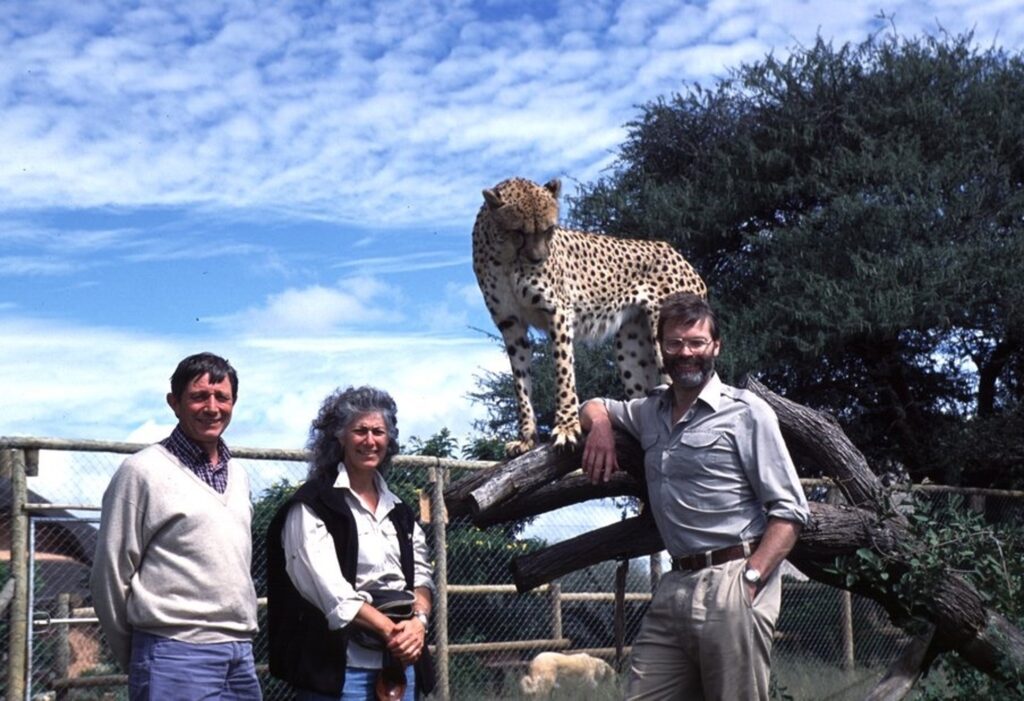
Gus Mills, Laurie Marker and David Macdonald, thinking about cheetahs in Namibia.